
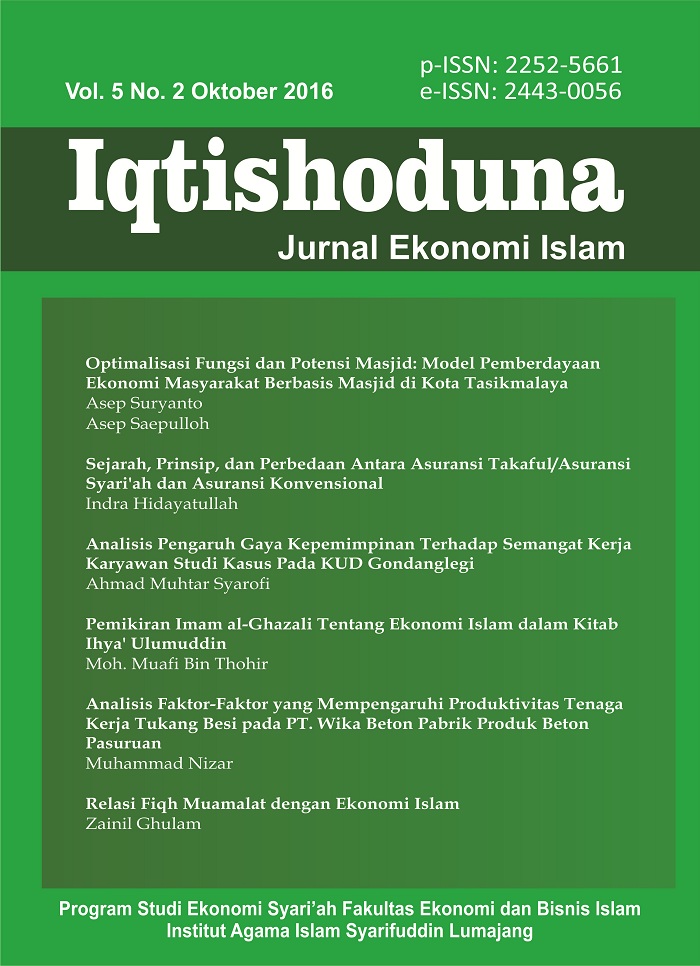
Optimalisasi Fungsi dan Potensi Masjid: Model Pemberdayaan Ekonomi Masyarakat Berbasis Masjid di Kota Tasikmalaya
Keywords:
Empowerment Model, Economic, MosqueAbstract
The purpose of this study are 1) to identify the economic potential possessed a mosque in the city of Tasikmalaya, 2) to identify the activities performed mosque in the city of Tasikmalaya, 3) to analyze the economic potential of the community around the mosque, especially worshipers of the mosque in the city of Tasikmalaya, 4) to formulate a model of mosque economic empowerment in the city of Tasikmalaya. This research is a qualitative study using grouded research methods that is advanced from the empirical toward the conceptual-theoretical level. The technique of collecting data using interviews, observation, and questionnaries. The results of research showed the following: 1) The economic potential possessed jami mosque in the city of Tasikmalaya includes potential funding of mosques each month between Rp. 400.000, - s / d Rp. 1.000.000, - on 56% jami mosque, while 44% are above Rp. 1.000.000, -. Type the mosque fund in the form of funds for donations, donation, charity malls, and endowments. As for the source of the donations of individuals, governments, businesses themselves DKM, and donations from organizations and companies. There is a mosque whose own treasury in the form of still modest. 2) the potential activities of the mosque as the carrying capacity of the economic empowerment of the mosque is the majlis taklim form study groups of mothers, fathers, and adolescents and the youth of the mosque. Some 86% of respondents agreed that the mosque functioned as a place of economic empowerment. 3) The economic potential of the mosque's congregation are categorized into two groups, namely muzaki and mustahik, with the percentage of 50:50. 4) Design of the mosque economic empowerment model that can be formulated based on the potential of the mosque provided is integrated model between agencies ZIS, Islamic microfinance and economic empowerment.
Downloads
References
Alfitri. 2011. Community Development : Teori dan Aplikasi, Cetakan ke-1, Yogyakarta : Pustaka Pelajar.
Aminudin, Teukeu. 2008. Masjid Dalam Pembangunan. Yogyakarta : UII.
Asqalani, al, Ibnu hajar. 1997.Fathul Qarib Syarah Shahih al Bukhari. Jilid 3. Riyadh : Maktabah Darussalam.
Ayub, Moh. E dkk. 1996. Manajemen Masjid. Jakarta : Gema Insani Press
Azra, Azyumardi. 2003. Berderma Untuk Semua. Jakarta : Mizan Publika.
Chapra,M. Umar. tt.The Islamic Welfare State and Its Role in the Economy, UK : The Islamic Foundation, Leicester
Dahlan, Abdul Azis. 1996. Ensiklopedi Hukum Islam. Jakarta : Ichtiar Baru Van Hoeve.
Dalmeri, 2014. Revitalisasi Fungsi Masjid sebagai Pusat Ekonomi dan Dakwah Multikultural. Jurnal Walissongo.Vol.22 No.2
Dusuki,Asyraf Wajdi. “Empowering Islamic Microfinance: Lesson from Group-Based Lending Scheme and Ibn Khaldun’s Concept of ‘Asabiyah”, presented at Monash University 4th International Islamic Banking and Finance Conference. Kuala Lumpu, on 13- 14 November, 2006
Friedmann,John. 1992.Empowerment : The Politics of Alternative Development, Malden : Blackwell Publihers.
Hafidudin, Didin, dkk, 2006, Agar Layar Tetap Berkembang Untuk Menyelamatkan Umat, Jakarta : Gema Insani Press.
Hariandja, Marihot Tua Efendi. 2007. Manajemen Sumber Daya Manusia, Jakarta : Gramedia Widiasarana Indonesia.
Harun, Nasrun. 2000. Fiqh Muamalah. Jakarta : Gaya Media Pratama.
Hutomo, Mardi Yatmo .“Pemberdayaan Masyarakat dalam Bidang Ekonomi : Tinjauan Teoritik dan Implementasi”, Paper dipresentasikan dalam acara Seminar Sehari Pemberdayaan Masyarakat yang diselenggarakan Bappenas di Jakarta, tanggal 6 Maret 2000, hlm. 3
Kartasasmita, Ginandjar. "Pemberdayaan Ekonomi Rakyat Melalui Kemitraan Guna Mewujudkan Ekonomi Nasional Yang Tangguh Dan Mandiri." Disampaikan Pada Seminar Nasional Lembaga Pembinaan Pengusaha Kecil Menengah dan Koperasi (LP2KMK-GOLKAR). 1996
Ilyas, Moh. Muchtar,dkk, 2008. Tipologi Masjid, Jakarta ; Direktorat Urusan Agama Islam dan Pembinaan Syariah Dirjen Bimbingan Masyarakat Islam DEPAG.
Imran, Carolina. 2008. Masjid sebagai Sentral Pemberdayaan Ekonomi Umat. Jakarta : UIN Syarif Hidayatullah.
Laila, Tanim. “Islamic Microfinance for Alleviating Poverty and Sustaining Peace”, Canakkale Onsekiz Mart University, Word Universites Congress, 20-24 Oct. 2010
Lee,Judith A. B. 2001.The Empowerment Approach to Social Work Practice Building the Beloved Community, Second Edition, New York : Columbia University Press.
Ma’mun, 2013. Pemanfaatan Masjid sebagai Pusat Pemberdayan Umat : Studi pada Masjid al Ikhlas Kota Pekanbaru, Jakarta : Balai Penelitian dan Pengembangan Agama.
Maryanto, Agus dan Azzah, t.t. Zaimul. Masjid Menara Qudus. Pustaka Oasis.
Maulany, R. 2008. Dahsyatnya Kekuatan Masjid. Bandung : Elkom Publisher.
Moeljarto,Vidhyandika. 1996. “Pemberdayaan Kelompok Miskin Melalui Program IDT”, dalam Onny S. Prijono dan A.M.W. Pranaka, Pemberdayaan : Konsep, Kebijakan, dan Implementasi. Jakarta : Centre for Strategic and International Studies (CSIS).
Mu’allim, Amir, 2012. Pengelolaan dan Pendayagunaan Zakat Berbasis Masjid di Yogyakarta, Yogyakarta : Jurnal Mukaddimah, Vol.18 No.1 UII
Mulkhan, Abdul Munir. 2009. Politik Santri. Yogyakarta : Kanisius
Munawir, Ahmad Warson. 1984. Al Munawwir Kamus Arab-Indonesia. Yogyakarta : Ponpes Krapyak.
Muslim, Azis. Manajemen Pengelolaan Masjid, Aplikasia : Jurnal Aplikasi Ilmu-ilmu Agama, Vol. V No. 2 Desember 2004. P. 105 – 114
Nahdi, Khirjan. Dinamika Pesantren Nahdatul Wathan Dalam Perspektif Pendidikan, Sosial, dan Moral. Islamica, Volume 7, No. 2 Tahun 2013, h. 381-405
Nasafi, al. tt. Tafsir al Nasafi, Jilid 4, Beirut : Darul Kutub Al-Arabi.
Robbins, T.L. M.D. Crino, L.D. Fredendall, An integrative model of the empowerment process, Human Resource Management Review 12 (2002) 419–443. 2002 Published by Elsevier Science Inc.
Roqib, Moh. 2009. Ilmu Pendidikan Islam : Pengembangan Pendidikan Integratif di Sekolah, Keluarga, dan Masyarakat. Yogyakarta : LKiS
Ruslan, Ismail, 2012. Pemberdayaan Masyarakat Berbasis Masjid di Pontianak. Jurnal Katulistiwa-Journal of Islamic Studies.Vol.2 Nomor 1.
Sani, M Anwar. 2010. Manajemen Zakat Berbasis Masjid. Jakarta : Gramedia Pustaka Utama.
Sarwat, Ahmad. 2012. Fiqh Kehidupan. Jakarta : DU Publising.
Sasono, Adi. 2008. Rakyat Bangkit Bangun Martabat. Jakarta : Alvabet dan Dekopi.
Soetomo. 2012. Pembangunan Masyarakat, Cetakan ke-2. Yogyakarta : Pustaka Pelajar.
Sugono, Dendi.2008. Kamus Besar Bahasa Indonesia, Jakarta :Pusat Bahasa Departemen Pendidikan Nasonal.
Suharto, Edi. 2014. Membangun Masyarakat Memberdayakan Rakyat : Kajian Strategis Pembangunan Kesejahteraan Sosial dan Pekerja Sosial, Cetakan ke-5, (Bandung : Refika Aditama.
Sutanto, Hery dan Pratiwi, Krisnandini Wahyu. Pengaruh Spiritual Capital dan Individual Value terhadap Job Performance pada Rumah Sakit di Wilayah Yogyakarta, Karisma, Vol.4(2): 79-90, 2010.
Strauss, Anselm & Corbin, Juliet. 2013. Dasar-dasar Penelitian Kualitatif, Yogyakarta : Pustaka Pelajar.
Tantoro,Swis. 2014.Pembasmian Kemiskinan perspektif Sosiologi Antropologi. Yogyakarta : Pustaka Pelajar.
Yasni, Gunawan Muhammad. 2007. Ekonomi Sufistik : Adil dan Membahagiakan. Bandung : Mizan Pustaka.
Yumna, Aimatul dan Clarke,Matthew. 2011.Integrating Zakat and Islamic Charities With Microfinance Initiative In The Purpose of Poverty Alleviation in Indonesia, Center for Islamic Economics and Finance, Qatar Faculty of Islamic Studies, Qatar Foundation.
Downloads
Published
How to Cite
Issue
Section
License
Copyright (c) 2016 Asep Suryanto, Asep Saepulloh

This work is licensed under a Creative Commons Attribution 4.0 International License.
The journal can be accessed publicly, which means that all content is provided freely accessible without charge to either the user or the institution. Users are allowed to read, download, copy, distribute, print, search, or cite to the full text of the article did not have to ask permission from the publisher or author.


