
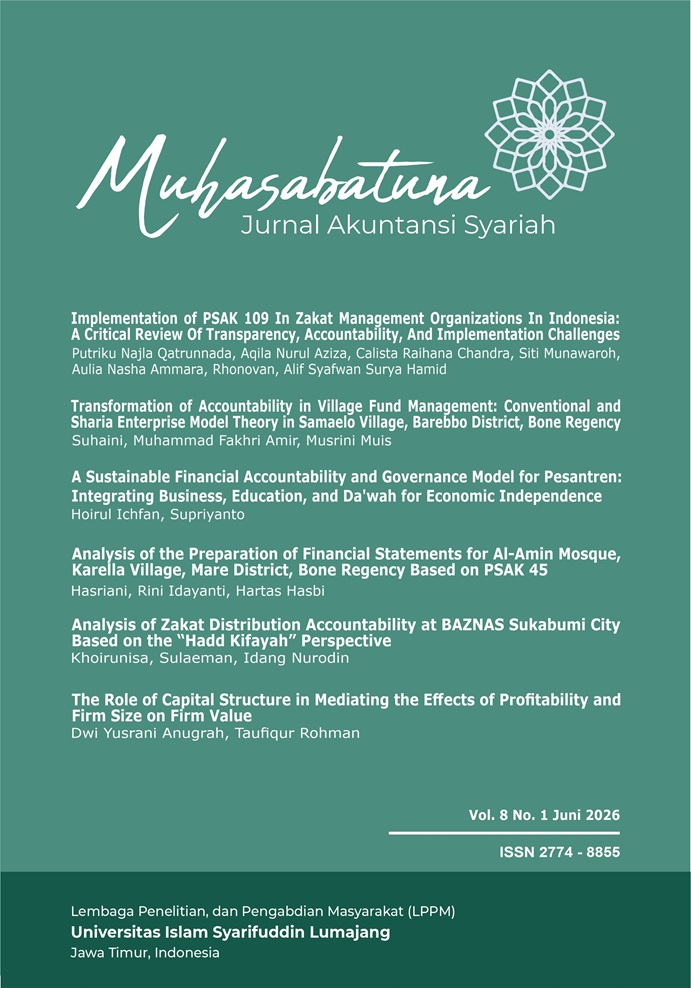
Analysis of Zakat Distribution Accountability at BAZNAS Sukabumi City Based on the “Hadd Kifayah” Perspective
DOI:
https://doi.org/10.54471/muhasabatuna.v8i1.3984Keywords:
accountability, zakat distribution, Had Kifayah, mustahik, BAZNASAbstract
Zakat plays a strategic role in poverty alleviation, yet national zakat collection realization has only reached 5.6% of its potential. Strong administrative accountability does not necessarily reflect substantive effectiveness in improving mustahik welfare. This study aims to analyze the implementation of zakat distribution accountability at BAZNAS Kota Sukabumi, the welfare level of mustahik based on the Had Kifayah perspective, and the contribution of accountability to that welfare. The study employs a qualitative descriptive method with a case study design. Data were collected through in-depth interviews with six informants (two BAZNAS staff and four mustahik), observation, and documentation, then analyzed using Ellwood's (1993) four accountability dimensions and the seven Had Kifayah dimensions from Puskas BAZNAS (2024). The results show that zakat distribution accountability at BAZNAS Kota Sukabumi has been adequately implemented, marked by an unqualified (WTP) audit opinion for ten consecutive years, a seven-stage distribution SOP, and the integration of Had Kifayah into mustahik assessment. However, program and policy evaluation remains output-oriented rather than outcome-oriented. In terms of welfare, the housing and transportation dimensions were fulfilled for nearly all informants, while the food dimension showed the largest gap. Program accountability provided the most direct contribution to mustahik fulfillment of Had Kifayah. This study recommends the systematic development of an outcome evaluation system based on Had Kifayah.
References
Abrori, F., & Marom, N. (2025). ILTIZAM: Jurnal Ekonomi dan Keuangan Islam PENETAPAN HAD KIFAYAH ZAKAT DAN KEMISKINAN EKSTRIM DALAM SOSIO EKONOMI ASNAF INFO ARTIKEL ABSTRACT. ILTIZAM : Jurnal Ekonomi Dan Keuangan Islam, 2(2), 63. https://journal.ibrahimy.ac.id/index.php/iltizam
BAZNAS. (2024). Laporan Akhir Tahun Zakat Nasional 2024 (BAZNAS). https://baznas.go.id/assets/images/szn/LPZ Nasional Akhir Tahun 2024.pdf?utm
Beik, I. S., & Arsyianti, L. D. (2016). EKONOMI PEMBANGUNAN SYARIAH. PT RajaGrafindo Persada.
Gustani, G., & Rohmah, S. (2021). Kelayakan Asnaf Fakir Miskin Sebagai Penerima Zakat Berdasarkan Had Kifayah. IQTISHADUNA: Jurnal Ilmiah Ekonomi Kita, 10(1), 62–75. https://doi.org/10.46367/iqtishaduna.v10i1.305
Mardiasmo. (2009). Akuntansi Sektor Publik. C.V ANDI OFFSET.
Muharam, F. (2025). AKUNTABILITAS PENGELOLAAN ZAKAT KOTA SUKABUMI. Journal Akuntansi Syariah, 9(7), 220–230.
Nofiansyah, E., & Pramono, S. E. (2024). Are The Accountability and Transparency Matters for Zakat Distribution Performance ? : An Empirical Evidence from BAZNAS Province. International Journal of Zakat, 2(2003), 55–66.
Purnama, L., Abidin, M., & Satibi, I. (2023). Indeks Zakat Nasional (IZN) Sebagai Basis Indeks Kelembagaan Zakat Di Baznas Provinsi D.I. Yogyakarta. Jurnal Magister Ekonomi Syariah, 2(1), 51–60.
Puskas BAZNAS. (2024). Kajian Penyesuaian Nilai Had Kifayah Tahun 2024. Pusat Kajian Strategis BAZNAS. https://www.puskasbaznas.com/publications/books/1878-penyesuaian-nilai-had-kifayah-tahun-2024
Sugiyono, P. D. (2023). METODE PENELITIAN KUANTITATIF, KUALITATIF, DAN R&D. ALFABETA, cv.
Zulfa, N. I., & Kartini, T. (2024). Analisis Penyaluran Dana Zakat Untuk Pemberdayaan Ekonomi Umat (Studi Kasus Pada Badan Amil Zakat Nasional Kota Sukabumi. Journal Of Social Science Research, 4(4), 14160–14170.
Downloads
Published
How to Cite
Issue
Section
License
Copyright (c) 2026 Khoirunisa, Sulaeman, Idang Nurodin

This work is licensed under a Creative Commons Attribution 4.0 International License.