
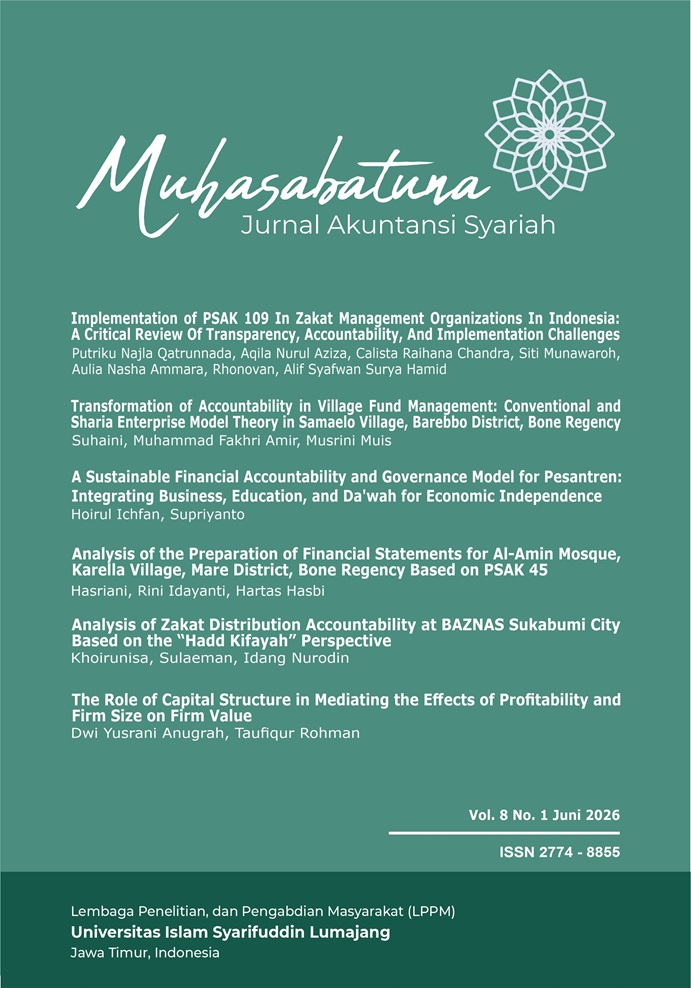
Transformation of Accountability in Village Fund Management: Conventional and Sharia Enterprise Model Theory in Samaelo Village, Barebbo District, Bone Regency
DOI:
https://doi.org/10.54471/muhasabatuna.v8i1.3956Keywords:
Accountability, Village Fund, Conventional Model, Syariah Enterprise Theory, TransparencyAbstract
This research aims to analyze the transformation of accountability in village fund management from the conventional model to the Syariah Enterprise Theory (SET) approach in Samaelo Village, Barebbo District, Bone Regency. The focus of this research is to examine the differences in accountability characteristics between the conventional model, which is administrative and regulatory in nature, and the SET approach, which emphasizes spiritual, moral, and social values in village financial management. This research uses a qualitative approach with data collection methods thru in-depth interviews, field observations, and documentation. The informants in this study include the village head, village officials, and the community involved in the village fund management process. The data obtained were analyzed descriptively to fulfilll the form and direction of the accountability transformation that occurs. The research results show that accountability in the conventional model places more emphasis on compliance with formal rules and the preparation of accountability reports. However, this approach does not yet fully reflect the values of substantive transparency and moral responsibility. On the contrary, the application of principles in Syariah Enterprise Theory encourages the realization of more comprehensive accountability, which is not only oriented toward the government and society but also toward spiritual responsibility to God. This transformation is reflected in the increasing awareness of village officials in applying the values of trustworthiness, honesty, justice, and transparency at every stage of village fund management. Based on the research results, it can be concluded that the integration of Sharia values in village fund management can strengthen the quality of accountability comprehensively, both from administrative, social, and spiritual aspects. Therefore, the Sharia Enterprise Theory approach can be used as an alternative in building a more integrity-oriented accountability system that focuses on the welfare of the community.
References
Astuti, An Ras Try, and Andi Faisal. “Tasawwuf Sebagai Lokomotif Syariah Enterprise Theory.” Al Ma’ Arief: Jurnal Pendidikan Sosial Dan Budaya 3, no. 1 (2021): 12–25.
B Waluya, Sosiologi: Menyelami Fenomena Sosial Di Masyarakat (PT Grafindo Media Pratama, n.d.).
Damin, Sudarwan. Menjadi Peneliti Kualitatif. (Bandung: CV Pustaka Setia, 2002).
Dana, Perencanaan, Desa Pada, Desa Tunglur, Kecamatan Badas, and Kabupaten Kediri. “Perencanaan Dana Desa Pada Desa Tunglur, Kecamatan Badas, Kabupaten Kediri.” Jurnal Pengabdian Masyarakat Bidang Akuntansi, Manajemen, Dan Ekonomi 1, no. 2 (2024): 41–44.
Diah Dewi Nawang Wulan, Herlina Helmy. “Analisis Penerapan Pengelolaan Dana Desa (Studi Kasus Pada Desa Sari Mulya Dan Desa Kuamang Kecamatan Jujuhan Ilir Kabupaten Bungo Provinsi Jambi).” Eksplorasi Akuntansi (JEA) 5, no. 1 (2023): 160–75.
Hasniati. “Model Akuntabilitas Pengelolaaan Dana Desa.” JUrnal Analisis Kebijakan Dan Pelayanan Publik 2, no. 1 (2016): 15–30.
Hardani, Metode Penelitian (Mataram: CV. Pustaka Ilmu Group Yogyakarta, 2020) h.104
Ida Ariani (Universitas Alauddin Makassar). “Akuntabilitas Pengelolaan Dana Desa Berbasis Syariah Enterprise Theory.” Universitas Alauddin Makassar, 2021.
Indonesia, Republik. “Undang-Undang Republik Indonesia Nomor 6 Tahun 2014 Tentang Desa.” ACM International Conference Proceeding Series 18-April-2, no. 1 (2016): 45–54. https://doi.org/10.1145/2904081.2904088.
Mardinata, Erwin, Tomy Dwi Cahyono, Reza Muhammad Rizqi, Program Studi, Bisnis Digital, Fakultas Ekonomi, Universitas Teknologi Sumbawa, Program Studi Akuntansi, Fakultas Ekonomi, and Universitas Teknologi Sumbawa. “PARTA : Jurnal Pengabdian Kepada Masyarakat Transformasi Digital Desa Melalui Sistem Informasi Desa ( SID ): Meningkatkan Kualitas Pelayanan Publik Dan Kesejahteraan Masyarakat Pendahuluan” 4, no. 1 (2023): 73–81.
Meleong, Lexy J. Metodologi Penelitian Kualitatif (Bandung: PT. Remaja Rosdakarya, 2007), h.4.
Mulyadi. “Implementasi Prinsip Tauhid Dalam Transformasi Akuntabilitas Pengelolaan Dana Desa Di Desa Samaelo.” Wawancara di Desa Samaelo, Kecematan Barebbo, Kabupaten Bone, Januari 2026, n.d.
Murniyanti, Sri. “Analisis Mekanisme Pengawasan Inspektorat Kabupaten Bireuen Terhadap Pengelolaam Dana Desa Kabupaten Bireuen Tahun2021.” Majalah Ilmiah Universitas Almuslim 14, no. 2 (2022): 91–94.
Pengelolaan, Transparansi, Dana Desa, and Evaluasi Kebijakan. “Transparansi Pengelolaan Dana Desa: Evaluasi Kebijakan Dan Implementasi.” Prosiding Seminar Nasional Indonesia 3, no. 2 (2025): 208–18.
Rahmawati, Maretta Ayu, Anggi Krisnawati, Savinathul Nadzah, Nanda Putri Widianti, and Harun Ar-Rasyid Utomo. “Implementasi Aplikasi Sistem Keuangan Desa (SISKEUDES) Sebagai Upaya Peningkatan Akuntabilitas Keuangan Desa Di Desa Tebel Kecamatan Gedangan Kabupaten Sidoarjo.” Sustainable Jurnal Akuntansi 4, no. 2 (2024): 197–210. https://doi.org/10.30651/stb.v4i2.24373.
Sari, Veti Kartika. “Transparansi Dan Akuntabilitas Pemerintah Desa Dalam Pengelolaan Alokasi Dana Desa.” Ilmu Dan Riset Akuntansi 10, no. 7 (2021): 8–16.
Sugiyono. Memahami Penelitian Kualitatif. Bandung: Alfabeta, 2010.
Waluya, B. Sosiologi: Menyelami Fenomena Sosial Di Masyarakat. PT Grafindo Media Pratama, n.d.
Yona Deswita, Aznuriyandi. “Transformasi Digital Dalam Tata Kelola Keuangan Desa : Dampak Pelatihan Dan Teknologi Informasi.” Mahasiswa Magister Manajemen 2, no. 1 (2025): 111–19.
Yunita Widya Caroline1, Dr. Asep Hendra. “Transformasi Pengelolaan Sistem Keuangan Desa (SISKEUDES) Berbasis Digital Di Kabupaten Indragira Hilir Provinsi Riau.” Http://Eprints.Ipdn.Ac.Id/, 2022.
Downloads
Published
How to Cite
Issue
Section
License
Copyright (c) 2026 Suhaini, Muhammad Fakhri Amir, Musrini Muis

This work is licensed under a Creative Commons Attribution 4.0 International License.