
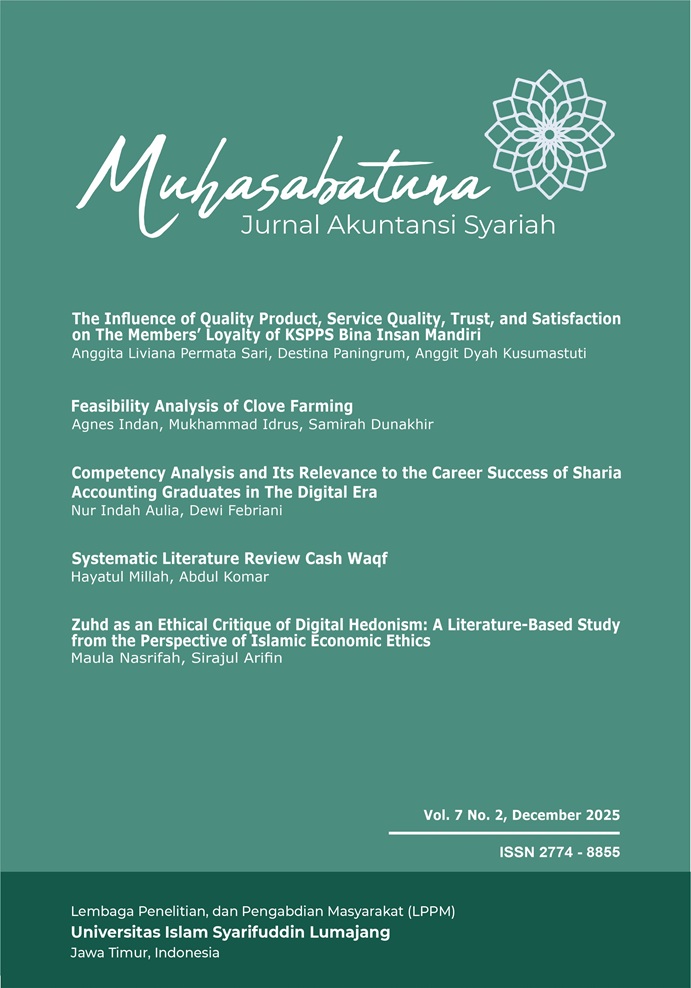
Zuhd as an Ethical Critique of Digital Hedonism: A Literature-Based Study from the Perspective of Islamic Economic Ethics
DOI:
https://doi.org/10.54471/muhasabatuna.v7i2.3809Keywords:
zuhd, digital hedonism, consumption ethics, Islamic economics, spiritual ethicsAbstract
Digital hedonism, which has intensified through social media, platform-based economies, and instant consumption culture, has fostered behavioral patterns oriented toward pleasure-seeking, excessive self-presentation, and self-commodification. These developments have generated significant ethical tensions in the consumption practices of Muslim communities. This article examines the concept of zuhd as an ethical critique of digital hedonism using a qualitative library research approach. Data were drawn from classical and contemporary Islamic literature as well as empirical studies on digital consumption and Islamic economic ethics. The analysis reveals that zuhd should not be understood as hostility toward pleasure or technology, but as a value-oriented framework that regulates consumption motives in accordance with spiritual objectives (maqāṣid al-sharīʿah). In the digital context, zuhd functions as an ethical compass that mitigates consumptive pressure, strengthens self-awareness, and reorients the moral use of technology. This study offers a conceptual contribution to the development of digital consumption ethics within Islamic economic thought.
References
Abdullah, M. (2021). Islamic ethics and contemporary consumption culture. Kuala Lumpur: IIUM Press.
Abu-Sulayman, A. H. (1993). Crisis in the Muslim mind. Herndon, VA: International Institute of Islamic Thought.
Alam, M. M., & Akbar, S. (2021). Religiosity, ethical consumption, and consumer decision-making in Muslim markets. Journal of Islamic Marketing, 12(5), 874–892. https://doi.org/10.1108/JIMA-05-2020-0132
Ali, M., Hassan, R., & Abd Rahman, N. (2022). Spiritual values and sustainable consumption behavior among Muslim millennials. International Journal of Ethics and Systems, 38(4), 651–670. https://doi.org/10.1108/IJOES-09-2021-0198
Asutay, M. (2020). Islamic moral economy: A theoretical framework and empirical examination. London: Routledge.
Beekun, R. I. (2012). Character-centered leadership: An Islamic perspective. Kuala Lumpur: International Islamic University Malaysia Press.
Belk, R. (2013). Extended self in digital worlds. Journal of Consumer Research, 40(3), 477–500.
Belk, R. (2020). The double-edged sword of materialism in digital consumption. Journal of Consumer Research, 47(4), 1–15.
Chan, T. K. H., Cheung, C. M. K., & Lee, M. K. O. (2022). Digital consumption dynamics: Examining impulsive buying and instant gratification on social media. Information & Management, 59(3), 103125.
Chapra, M. U. (2016). The future of economics: An Islamic perspective. Leicester: The Islamic Foundation.
Dhir, A., Kaur, P., Rakesh, S., & Khalid, M. (2021). Adolescent social media engagement and materialism: The mediating role of social comparison. Technological Forecasting and Social Change, 172, 121044.
Djafarova, E., & Trofimenko, O. (2019). Exploring the relationships between self-presentation, social media engagement, and consumption. Journal of Retailing and Consumer Services, 50, 87–94.
Djalil, M. A. (2020). Digital consumption and Muslim consumer ethics. Journal of Islamic Economics, Banking and Finance, 16(2), 45–60.
al-Ghazālī, A. H. (1997). Iḥyāʾ ʿUlūm al-Dīn. Beirut: Dār al-Maʿrifah.
Hassan, A., Noor, F., & Haron, H. (2021). Islamic moderation and its impact on consumer ethics in Muslim societies. International Journal of Islamic and Middle Eastern Finance and Management, 14(3), 485–502.
Hidayat, S., & Pratama, A. (2021). Digital lifestyle and consumer behavior in Muslim societies. Journal of Islamic Marketing, 12(8), 1523–1540.
Hussin, R. (2019). Spirituality and consumption in Islamic thought. Intellectual Discourse, 27(1), 201–223.
Ibn Qayyim al-Jawziyyah. (2009). Madārij al-Sālikīn. Cairo: Dār Ibn al-Jawzī.
Kahf, M. (2018). The Islamic economy: Analytical perspectives. Jeddah: Islamic Research and Training Institute.
Kamali, M. H. (2019). The middle path of moderation in Islam. Oxford: Oxford University Press.
Kaur, P., Dhir, A., & Rakesh, S. (2023). Mindful digital use and its effects on impulse buying behavior. Telematics and Informatics, 76, 101924.
Kim, J., & Kim, M. (2020). Online self-presentation and image-based consumption. Computers in Human Behavior, 105, 106207.
Mahmood, T., & Bashir, S. (2022). The role of Islamic spirituality in shaping sustainable economic decision-making. Humanomics, 38(1), 123–139.
Nawawī, I. (1996). Riyāḍ al-Ṣāliḥīn. Beirut: Dār al-Fikr.
Nugroho, A. (2023). Visual culture and digital consumption behavior. Journal of Digital Society, 5(1), 33–47.
Przybylski, A. K., Murayama, K., DeHaan, C. R., & Gladwell, V. (2013). Motivational, emotional, and behavioral correlates of fear of missing out. Computers in Human Behavior, 29(4), 1841–1848.
Rahman, K., & Al-Kandari, A. (2022). Social media, consumption desire, and Muslim youth ethics. Journal of Islamic Marketing, 13(6), 1285–1302.
Sedera, D., & Lokuge, S. (2021). The psychology of social media fame: Understanding online self-presentation. Information Systems Journal, 31(2), 1–22.
Sohn, S. Y. (2020). Social media addiction and impulse buying: A review of the literature. Journal of Retailing and Consumer Services, 54, 102127.
Suryani, T. (2022). Digital hedonism and consumer culture in Southeast Asia. Asian Journal of Social Science, 50(3), 211–228.
Yusuf, A., & Jaafar, N. (2023). Zuhd orientation and its implications for modern economic behavior: A conceptual re-examination. Journal of Islamic Economics, Banking and Finance, 19(1), 1–18.
Downloads
Published
How to Cite
Issue
Section
License
Copyright (c) 2026 Maula Nasrifah, Sirajul Arifin

This work is licensed under a Creative Commons Attribution 4.0 International License.