
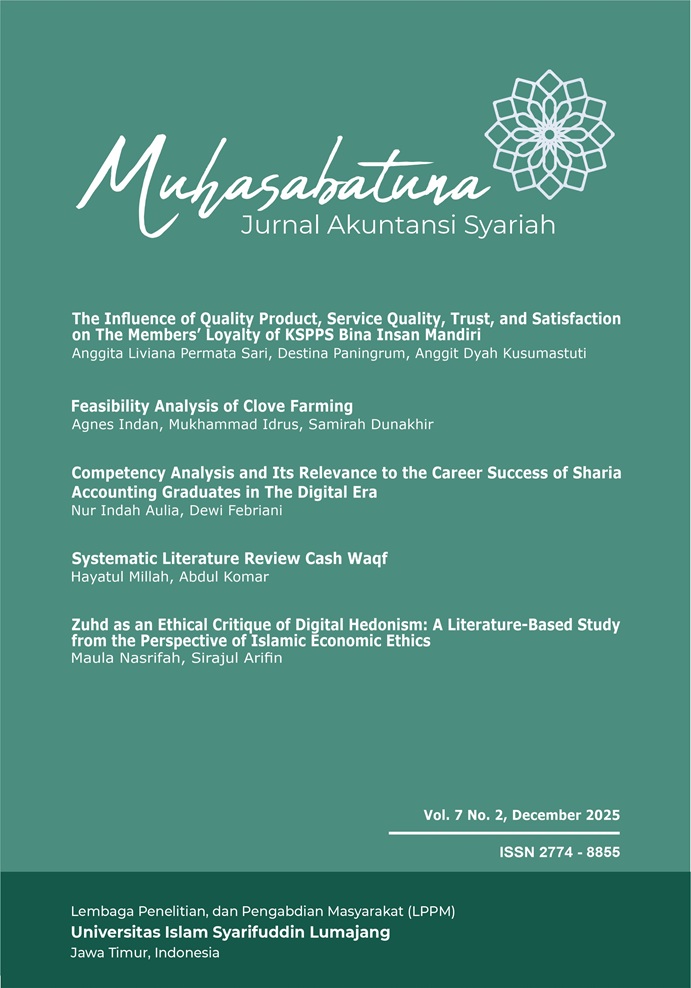
Competency Analysis and Its Relevance to the Career Success of Sharia Accounting Graduates in The Digital Era
DOI:
https://doi.org/10.54471/muhasabatuna.v7i2.3458Keywords:
Career Success, Graduate Competencies, Curriculum Relevance, Digital EraAbstract
This study examines the effect of graduate competencies on career success in the digital era and assesses the relevance of the Sharia Accounting curriculum to graduates’ career outcomes. A quantitative approach was employed using purposive sampling, with data collected through questionnaires administered to Sharia Accounting graduates of IAI Tazkia (cohorts 14–18). The data were analyzed using descriptive statistics and Partial Least Squares–Structural Equation Modeling (PLS-SEM). The findings reveal that graduate competencies have a significant positive effect on career success in the digital era, while curriculum relevance does not exhibit a direct effect. This study recommends continuous curriculum enhancement to align with industry dynamics and labor market needs. The study is limited by its single-institution sample, which may restrict the generalizability of the findings.
References
Abdullah, M. N. C. & T. A. T. (2011). What Accountancy Skills Are Acquired at College? International Journal of Business & Social Science, 2(18), 193–199. http://search.ebscohost.com/login.aspx?direct=true&db=bth&AN=66726543&site=ehost-live
Agustin, V. (2012). Kompetensi Lulusan Sarjana Strata 1 (S1) Psikologi dalam Menghadapi Dunia Kerja Pada Mahasiswa Perguruan Tinggi “X”. Calyptra: Jurnal Mahasiswa Universitas Surabaya, 1(1), 1–34.
Alhamuddin. (2016). KURIKULUM PENDIDIKAN TINGGI KEAGAMAAN ISLAM: MUTU DAN RELEVANSI. Alhamuddin, Kurikulum Pendidikan Tinggi Keagamaan Islami KURIKULUM, 3(Juli), 1–15.
Amiruddin, M. (2019). Pengaruh Kepuasan Karir Terhadap Kesuksesan Karir Melalui Komitmen Karir Studi Pada Pt Aneka Gas Industri Region V Sidoarjo. Jurnal Ilmu Manajemen, 7(1), 51–59.
Anih, E. (2015). Manajemen Implementasi Kebijakan Pengembangan Kurikulum Di Perguruan Tinggi Berbasis Kompetensi. Jurnal Pendidikan Unsika, 3(1), 1–21.
Anindita, H., & Muafi, M. (2021). Pengaruh Kepribadian Proaktif, Kinerja Kerja, Promosi Diri terhadap Kesuksesan Karir Karyawan Ponpes Surya Global. JBTI : Jurnal Bisnis : Teori Dan Implementasi, 11(3), 206–216. https://doi.org/10.18196/bti.113141
Aprilyanti, S. (2017). Pengaruh Usia dan Masa Kerja Terhadap Produktivitas Kerja (Studi Kasus: PT. OASIS Water International Cabang Palembang). Jurnal Sistem Dan Manajemen Industri, 1(2), 68. https://doi.org/10.30656/jsmi.v1i2.413
Arifin, M., & Hs, R. H. H. (2017). Lulusan Dengan Dunia Kerja Menggunakan Uml. IC- Tech, XII(2), 42–49.
Danang, Holik, A., & Nur Iska, L. (2021). Efek Usia dan Tingkat Pendidikan terhadap Kinerja Tenaga Bantu Penyuluh Pertanian. Jurnal Penyuluhan, 17(1), 52–59. https://doi.org/10.25015/17202131614
Djamilah, S. (2021). Dampak Gender Pada Karir: Kajian Karir Plateau Dan Strategi Karir. Media Mahardhika, 19(2), 300–315. https://doi.org/10.29062/mahardika.v19i2.255
Fadillah Rozi dan Sulastini, Sulastini, & Hidayati, N. (2017). Pengaruh Kompetensi, Disiplin Kerja, dan Lingkungan Kerja Terhadap Kinerja Karyawan Pada Kantor Bank Kalsel Cabang Pembantu Banjarmasin. Jurnal Bisnis Dan Pembangunan, 6(1), 1–9.
Garnasih, R. L. (2017). Motivasi: Expectancy Theory Dan Produktivitas Penelitian. Jurnal Inspirasi Bisnis Dan Manajemen, 1(1), 53. https://doi.org/10.33603/jibm.v1i1.492
Hiim, H. (2017). Ensuring curriculum relevance in vocational education and training: Epistemological perspectives in a curriculum research project. International Journal for Research in Vocational Education and Training, 4(1), 1–19. https://doi.org/10.13152/IJRVET.4.1.1
Hingston, P. A., & Bracewell, D. D. (2021). Strengthening undergraduate food science programs: Comparing industry relevance of the Institute of Food Technologists’ Essential Learning Outcomes with graduate proficiency levels. Journal of Food Science Education, 20(4), 130–145. https://doi.org/10.1111/1541-4329.12227
Humaira, F., Agung, S., & Kuraesin, E. (2020). Pengaruh Integritas Dan Pengembangan Karir Terhadap Kinerja Karyawan. Manager : Jurnal Ilmu Manajemen, 2(3), 329. https://doi.org/10.32832/manager.v2i3.3706
Karim, K., & Tajibu, M. J. (2018). Keterkaitan Usia dan Iklim Organisasi Terhadap Prestasi Kerja Karyawan Bank di Makasar, The Linkage of Age and Organizational Development to the Work Achievement of Bank Employees in Makassar. SEIKO: Journal of Management & …, 2(1), 73–91. https://journal.stieamkop.ac.id/index.php/seiko
Lukito, C. D. R. (2020). Determinasi Kepribadian Proaktif Terhadap Kesuksesan Karir Melalui Leader Member Exchange. Jurnal Ilmu Manajemen, 8(1), 265–275.
Muhson, A., Wahyuni, D., Supriyanto, S., & Mulyani, E. (2012). Analysis of the Relevance of Higher Education Graduates to the World of Work. Jurnal Economia, 8(1), 42–52. https://journal.uny.ac.id/index.php/economia/article/view/800
Pan, J., & Zhou, W. (2013). Can success lead to happiness? The moderators between career success and happiness. Asia Pacific Journal of Human Resources, 51(1), 63–80. https://doi.org/10.1111/j.1744-7941.2012.00033.x
Prabowo, A., & Ameliyah, L. (2020). Masyarakat Ekonomi ASEAN (MEA): Persepsi Kompetensi Lulusan Akuntansi di Jakarta. AKTSAR: Jurnal Akuntansi Syariah, 3(1), 81. https://doi.org/10.21043/aktsar.v3i1.7117
Rahmi, F., & Puspasari, D. (2017). Kematangan Karir Ditinjau Dari Jenis Kelamin Dan Jenis Sekolah Di Kota Padang. Jurnal RAP (Riset Aktual Psikologi Universitas Negeri Padang), 8(1), 24–35. http://ejournal.unp.ac.id/index.php/psikologi/article/view/7949
Ramly, A. Z. (2018). Pengaruh Hambatan Karier Terhadap Kesuksesan Karir Dengan Locus of Control Sebagai Variabel Moderator Pada PT PLN (Persero) Unit Induk Pembangunan Vii Surabaya. Jurnal Ilmu Manajemen, 6(2016), 1–7.
Ratnaningsih, I. Z., Kustanti, E. R., Prasetyo, A. R., & Fauziah, N. (2017). Kematangan Karier Siswa Smk Ditinjau Dari Jenis Kelamin Dan Jurusan. Humanitas, 13(2), 112. https://doi.org/10.26555/humanitas.v13i2.6067
Rode, J. C., Arthaud-Day, M. L., Mooney, C. H., Near, J. P., & Baldwin, T. T. (2008). Ability and personality predictors of salary, perceived job success, and perceived career success in the initial career stage. International Journal of Selection and Assessment, 16(3), 292–299. https://doi.org/10.1111/j.1468-2389.2008.00435.x
Supriati, & Handayani, T. (2018). Relevansi Lulusan Perguruan Tinggi dalam Penempatan Kerja. Seminar Nasional Industri Dan Teknologi (SNIT), Politeknik Negeri Bengkalis Relevansi, Lcm, 10–12.
Utari, R. A., & Widodo, J. (2019). Pengaruh Kepemimpinan Instruksional Guru Dan Fasilitas Kelas Terhadap Prestasi Belajar Siswa Melalui Motivasi Belajar. Economic Education Analysis Journal, 7(3), 1040–1055. https://doi.org/10.15294/eeaj.v7i3.28338
Wigfield, A., & Eccles, J. S. (2000). Expectancy-value theory of achievement motivation. Contemporary Educational Psychology, 25(1), 68–81. https://doi.org/10.1006/ceps.1999.1015
Wu, W., Ao, X., & Li, F. (2020). On curriculum relevance of the information management and information system major in the age of big data. Journal of Physics: Conference Series, 1550(3). https://doi.org/10.1088/1742-6596/1550/3/032147
Downloads
Published
How to Cite
Issue
Section
License
Copyright (c) 2026 Nur Indah Aulia, Dewi Febriani

This work is licensed under a Creative Commons Attribution 4.0 International License.